Many independent schools across Australia already own buses.
They’ve invested in vehicles, branding, and long-term fleet assets — often to maintain control, reduce long-term costs, or ensure consistency for students and families.
But owning buses is no longer the hardest part.
Managing them safely, compliantly, and efficiently is.
From tightening driver accreditation rules to increasingly complex maintenance schedules, schools are discovering that running an in-house fleet without professional systems now carries operational risk, compliance exposure, and hidden workload.
That’s where the hybrid advantage comes in.
Rather than replacing your fleet, StudentRide helps schools integrate their existing vehicles into a professional-grade transport ecosystem — combining ownership control with enterprise-level fleet management, compliance oversight, and operational intelligence.
Why Owning Buses Isn’t Enough Anymore
Historically, school-owned buses were simple to manage:
- A handful of drivers
- Fixed routes
- Paper logs
- Manual servicing reminders
Today, expectations have changed — from regulators, insurers, parents, and school boards alike.
Modern schools now face:
- Mandatory driver accreditation tracking
- Ongoing WWCC and licence validation
- Digital maintenance records
- Fatigue and duty-of-care scrutiny
- Parent expectations around transparency and safety
- Board-level risk accountability
In short, schools are being held to the same standards as commercial operators, without having commercial systems.
This is where many in-house fleets start to feel stretched.
The Hidden Pain Points of In-House Fleet Management
1. Maintenance Schedules That Rely on Memory (or Spreadsheets)
Missed servicing windows don’t just create mechanical risk — they can invalidate insurance and expose schools to serious liability.
Common challenges include:
- Multiple vehicles on different service cycles
- Inconsistent record-keeping
- Paper invoices scattered across departments
- No central visibility for auditors or insurers
Without a systemised approach, maintenance becomes reactive instead of preventative.
2. Driver Accreditation Is Increasingly Complex
Driver compliance is no longer a “set and forget” task.
Schools must track:
- Driver licences (including class and expiry)
- Working With Children Checks
- Medical declarations
- Training records
- Inductions and ongoing competency reviews
Relying on manual reminders or HR spreadsheets increases the risk of:
- Expired documentation
- Non-compliant drivers operating vehicles
- Exposure during audits or incidents
3. Knowledge Lives in One Person’s Head
Many schools rely on one experienced staff member who “just knows how it all works”.
That’s fine — until:
- They’re away
- They leave
- They retire
- Or something goes wrong
Operational knowledge without system support creates single-point-of-failure risk.
What Is the Hybrid Model in School Transport?
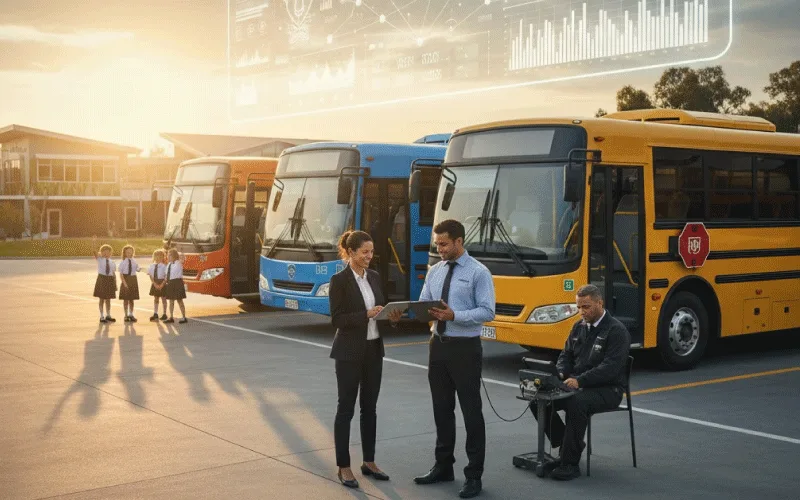
The hybrid model blends:
- Your school-owned vehicles
- Your preferred drivers
- Professional fleet and compliance systems
- Optional access to external operators when needed
Instead of choosing between:
- Full outsourcing or
- Fully in-house management
Schools get the best of both worlds.
How StudentRide Integrates Your Existing Fleet
StudentRide is not a bus operator replacing your vehicles.
It is a transport management platform and strategic partner that wraps professional systems around the fleet you already own.
Your buses remain:
- School-owned
- School-branded
- School-controlled
But they operate within a commercial-grade management framework.
Professional Maintenance Oversight — Without Extra Admin
StudentRide centralises fleet maintenance into a single dashboard, allowing schools to:
- Track service schedules by vehicle
- Store digital service records
- Monitor upcoming compliance deadlines
- Maintain auditable maintenance histories
- Reduce reliance on manual reminders
This creates:
- Better planning
- Fewer surprises
- Stronger insurer confidence
- Clear audit trails
Driver Accreditation, Digitised and Monitored
Instead of chasing paperwork, StudentRide provides structured compliance tracking for:
- Driver’s licences and endorsements
- WWCC expiry dates
- Medical requirements
- Induction and training records
Automated alerts flag risks before they become problems, helping schools demonstrate proactive governance rather than reactive firefighting.
One System for Daily Runs and Ad-Hoc Trips
Many schools run:
- Daily home-to-school routes and
- Excursions, camps, sport, and events
Without a central platform, these sit in different systems — or worse, different inboxes.
StudentRide allows schools to:
- Manage daily services
- Coordinate ad-hoc trips
- Assign in-house buses first
- Seamlessly supplement with external operators when required
This prevents:
- Overbooking
- Under-utilised assets
- Last-minute transport scrambles
When Hybrid Becomes a Financial Advantage
Owning buses is a major investment — but only if they’re used efficiently.
The hybrid model helps schools:
- Maximise utilisation of owned vehicles
- Reduce unnecessary outsourcing
- Maintain predictable operating costs
- Avoid emergency hire premiums
For many schools, this leads to lower total transport spend, even after professional management is introduced.
Governance, Risk & Board Confidence
Increasingly, school transport decisions are scrutinised at board level.
StudentRide supports governance by providing:
- Centralised data
- Transparent reporting
- Clear accountability frameworks
- Defensible compliance processes
This matters when:
- Insurance is reviewed
- Incidents are investigated
- Regulators ask questions
- Parents seek reassurance
A Smarter Path Forward for School-Owned Fleets
The question for many schools is no longer:
“Should we own buses or outsource transport?”
It’s now:
“How do we professionally manage the assets we already own?”
The hybrid advantage offers a modern, flexible answer — preserving control while eliminating unnecessary risk.
Who This Model Is Best For
The hybrid approach is ideal for:
- Independent schools with existing fleets
- Schools planning future fleet expansion
- Campuses running daily routes and frequent excursions
- Schools facing increasing compliance pressure
- Business Managers seeking stronger oversight without headcount growth
Final Thought: Ownership with Confidence
Owning buses doesn’t have to mean carrying all the risk alone.
With the right systems, schools can:
- Keep control
- Improve safety
- Reduce admin burden
- Strengthen compliance
- Build long-term resilience
That’s the hybrid advantage — and it’s how modern schools are future-proofing transport.