Driver accreditation is one of the most closely scrutinised compliance areas in Australian school transport. In 2026, schools are expected to demonstrate continuous oversight of driver licences, Working With Children Checks, medical fitness, inductions, and ongoing competency — not just collect documents annually.
Auditors and insurers now focus on whether schools actively monitor expiry dates, respond to risks before breaches occur, and maintain auditable evidence of compliance. Manual reminders and spreadsheet tracking are increasingly viewed as insufficient, particularly for schools operating in-house fleets or managing multiple transport providers.
A structured driver accreditation system allows schools to centralise records, automate alerts, and clearly demonstrate governance to boards and insurers. Whether transport is in-house, outsourced, or hybrid, proactive accreditation management reduces audit exposure, strengthens duty-of-care obligations, and improves long-term transport resilience.
Driver accreditation is now one of the most scrutinised risk areas in school transport.
In 2026, it’s no longer enough for schools to simply collect documents.
They must be able to prove ongoing, continuous compliance — at any time.
For Australian independent schools operating in-house buses, outsourced services, or hybrid transport models, driver accreditation failures are among the fastest ways to invalidate insurance, fail audits, or expose leadership teams to serious governance risk.
This article provides a clear, practical compliance checklist — and explains how leading schools are moving from reactive paperwork to proactive accreditation management.
Why Driver Accreditation Is a High-Risk Area
From an insurer or auditor’s perspective, driver compliance failures are:
- Predictable
- Preventable
- Entirely avoidable
Yet they remain one of the most common audit findings in school transport reviews.
Why?
Because accreditation often relies on:
- Manual reminders
- HR spreadsheets
- Annual checks
- Individual staff vigilance
That approach no longer meets modern expectations.
What “Driver Accreditation” Really Means in 2026
Driver accreditation is not a single document.
It is a living compliance framework that must be actively monitored.
Auditors and insurers now expect schools to manage — and evidence — all of the following.
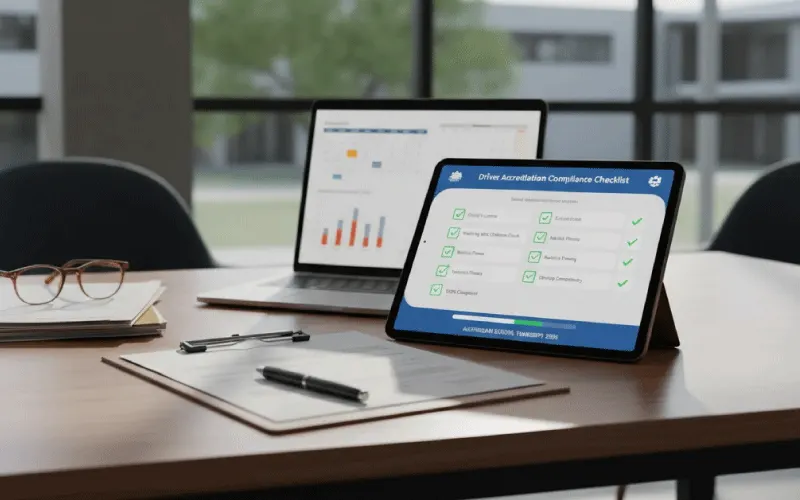
The 2026 Driver Accreditation Checklist (Australia)
1. Valid Driver Licence (Correct Class)
Schools must confirm:
- Licence class matches vehicle type
- Licence remains current
- Any restrictions are documented
Common risk:
Licence expiry is checked once per year instead of continuously.
2. Working With Children Check (WWCC)
Expectations include:
- Valid WWCC at all times
- Correct state registration
- Evidence of ongoing monitoring, not just initial clearance
Audit issue:
Expired WWCC discovered after a driver has already operated a service.
3. Medical Fitness to Drive
Depending on state and vehicle class:
- Medical declarations may be mandatory
- Periodic reassessment may be required
- Records must be retained and accessible
Hidden risk:
Medical requirements often fall between HR and operations — and get missed.
4. Driver Induction & School-Specific Training
Auditors increasingly ask:
- Has the driver completed a school-specific induction?
- Are child safety expectations documented?
- Is training refreshed periodically?
Generic inductions are no longer sufficient.
5. Ongoing Competency & Behaviour Monitoring
Best practice schools track:
- Incident history
- Near-misses
- Complaints
- Feedback patterns
This shows active supervision, not passive employment.
6. Accreditation Expiry Monitoring & Alerts
This is where many schools fail.
Auditors expect:
- Automated expiry alerts
- Clear escalation pathways
- Evidence of intervention before expiry
Manual calendar reminders rarely meet scrutiny.
The Difference Between “Having Documents” and “Being Compliant”
This distinction matters.
Having Documents | Being Compliant |
Files stored | Expiry monitored |
Annual checks | Continuous oversight |
Reactive updates | Proactive alerts |
Verbal assurance | Auditable evidence |
In audits, only the right-hand column counts.
Accreditation Risk in In-House vs Outsourced Models
In-House Transport
- Full responsibility sits with the school
- Higher exposure if systems are informal
- Accreditation failures are direct governance failures
Outsourced Transport
- Schools must still verify compliance
- “Trusting the provider” is no longer acceptable
- Due diligence must be documented
Hybrid Models
- Accreditation managed centrally
- Clear accountability
- Consistent oversight across all drivers
This is one reason hybrid models are gaining traction.
How Leading Schools Are Managing Accreditation in 2026
High-performing schools share three traits:
- Centralised records
- Automated monitoring
- Board-level visibility
They do not rely on individual memory or goodwill.
Where StudentRide Supports Driver Accreditation
StudentRide helps schools move from manual compliance to structured, defensible accreditation management.
With professional transport oversight systems, schools can:
- Centralise driver records
- Monitor expiry dates automatically
- Trigger alerts before risks occur
- Maintain auditable compliance histories
- Demonstrate proactive governance to insurers and boards
Importantly, this applies whether drivers are:
- School-employed
- Externally supplied
- Or part of a hybrid model
What Auditors and Insurers Want to See
In one sentence:
Evidence that driver accreditation is actively managed, not passively collected.
Anything less is increasingly considered an avoidable risk.
Final Checklist: Are You Audit-Ready?
Ask yourself:
- Could we show current driver compliance today?
- Would expiry risks be flagged before becoming breaches?
- Is accountability clearly defined?
- Could this withstand insurer or regulator scrutiny?
If the answer is uncertain, the risk is real.
FAQs
Q1. What is driver accreditation in school transport?
Driver accreditation refers to the ongoing verification of licences, Working With Children Checks, medical fitness, training, and compliance required for drivers transporting students.
Q2. How often should schools check driver accreditation?
Driver accreditation should be monitored continuously, with automated alerts for expiries — not just reviewed annually.
Q3. Do schools remain responsible for driver compliance if transport is outsourced?
Yes. Schools retain the duty of care and must verify that external providers maintain compliant, accredited drivers.
Q4. What causes most driver accreditation audit failures?
Common failures include expired licences or WWCCs, lack of monitoring systems, missing training records, and reliance on manual reminders.
Q5. How can schools reduce driver compliance risk in 2026?
By centralising records, automating expiry tracking, assigning clear accountability, and maintaining auditable evidence of compliance.
Final Thought: Accreditation Is a System, Not a Task
In 2026, driver accreditation is no longer a once-a-year admin job.
It is an ongoing compliance system — and one of the clearest signals of transport maturity in schools.
Schools that get this right:
- Reduce insurance friction
- Strengthen governance
- Protect leadership teams
- Reassure parents
- Future-proof transport operations