Australian independent schools are increasingly reassessing how they manage student transport, weighing in-house operations against full outsourcing. While in-house transport offers control and long-term asset value, it carries growing compliance, insurance, and governance responsibilities. Outsourced transport reduces operational burden but can increase long-term costs and limit visibility over safety and compliance.
A hybrid school transport model is emerging as a preferred alternative. This approach allows schools to retain ownership of buses and drivers while introducing professional systems to manage compliance, maintenance, and operational oversight. By centralising records and monitoring risk proactively, schools can reduce exposure without sacrificing control.
Decision-makers are now comparing transport models not just on price, but on risk, resilience, and board-level accountability. The most effective approach in 2026 is one that balances cost efficiency with defensible governance — particularly in an environment of heightened insurer scrutiny and regulatory expectations.
Rising compliance requirements, insurer scrutiny, and growing expectations from parents mean schools are asking harder questions about how transport should be managed — not just how much it costs.
The most common dilemma is this:
Should we run transport in-house, outsource it entirely, or take a hybrid approach?
This article breaks down in-house vs outsourced school transport across the three factors that matter most to decision-makers:
- Cost
- Risk
- Control
And importantly, it explains why a growing number of schools are choosing neither extreme.
Option 1: Fully In-House School Transport
Many schools operate their own buses for good reasons:
- Long-term investment already made
- Consistent branding and culture
- Familiar drivers and routes
- Perceived cost savings
Where In-House Works Well
In-house transport often performs best when:
- Routes are predictable
- Fleet size is small
- Key staff have long tenure
- Compliance requirements are stable
The Real Cost Picture
While day-to-day costs may appear lower, true costs include:
- Vehicle depreciation
- Maintenance and downtime
- Driver recruitment and backfill
- Compliance administration
- Insurance exposure
These costs are often spread across departments, making them harder to see clearly.
Risk Profile
This is where pressure is increasing.
Schools with in-house fleets carry full responsibility for:
- Driver accreditation
- Maintenance compliance
- Incident management
- Audit readiness
- Governance reporting
Without professional systems, risk often relies on:
- Manual processes
- Individual knowledge
- Good intentions rather than evidence
Option 2: Fully Outsourced School Transport
Outsourcing is often seen as the “safe” choice — but it comes with trade-offs.
Where Outsourcing Works Well
- Variable or seasonal demand
- No appetite for fleet ownership
- Limited internal capacity
- Short-term or ad-hoc transport needs
Cost Reality
Outsourcing offers:
- Predictable per-trip pricing
- No capital expenditure
- No fleet maintenance responsibility
However:
- Costs escalate quickly with frequent use
- Emergency bookings attract premiums
- Long-term daily routes become expensive
Risk Profile
Outsourcing does not eliminate risk — it shifts it.
Schools remain responsible for:
- Provider due diligence
- Verifying compliance
- Managing incidents
- Duty of care to students
A common misconception is:
“If it’s outsourced, it’s not our risk.”
In audits and incidents, that assumption rarely holds.
Option 3: The Hybrid Model (Where Most Schools Are Landing)
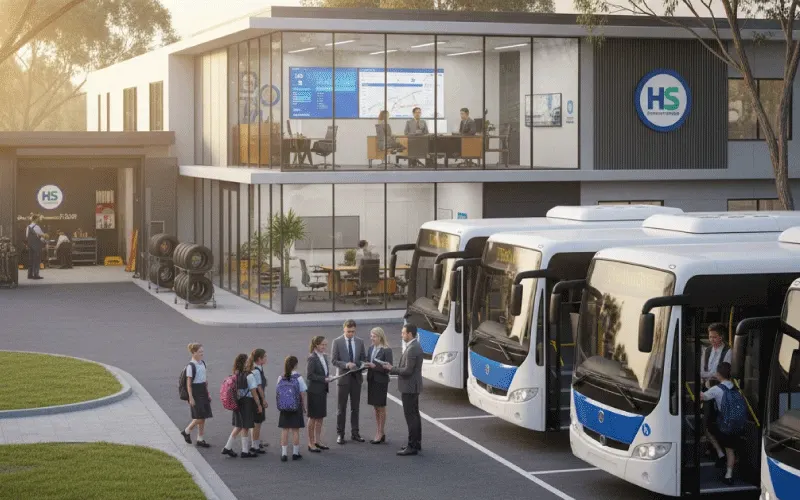
Increasingly, schools are choosing a hybrid approach — combining the strengths of both models while reducing their weaknesses.
What Hybrid Transport Looks Like in Practice
- School-owned buses remain in operation
- School-employed drivers continue working
- Professional systems manage compliance and oversight
- External providers supplement peak demand
- Centralised visibility across all transport activity
This model prioritises control where it matters most and flexibility where it’s needed.
Side-by-Side Comparison: Cost, Risk & Control
Cost
In-House
- Lower marginal cost per trip
- Higher hidden overheads
- Capital tied up in assets
Outsourced
- Predictable short-term costs
- High long-term spend for frequent use
Hybrid
- Maximises existing assets
- Reduces unnecessary outsourcing
- Improves cost predictability
Risk
In-House
- Highest exposure without systems
- Audit and insurance risk increases over time
Outsourced
- Risk still sits with the school
- Limited visibility unless actively managed
Hybrid
- Risk actively monitored
- Evidence-based compliance
- Stronger audit defensibility
Control
In-House
- High control, low resilience if key staff leave
Outsourced
- Low operational control
- Reliant on third parties
Hybrid
- Strategic control with operational support
- Reduced single-point-of-failure risk
Why Boards Are Favouring Hybrid Models
From a governance perspective, the hybrid model answers three critical board questions:
- Do we know who is responsible for transport risk?
- Can we demonstrate compliance at any time?
- Are we over-exposed to operational or reputational risk?
Hybrid systems make transport:
- Visible
- Reportable
- Defensible
Where StudentRide Fits Into the Decision
StudentRide supports the hybrid model by professionalising transport oversight without forcing schools to abandon their existing fleets.
Schools using structured transport platforms gain:
- Centralised driver accreditation tracking
- Digital maintenance records
- Real-time visibility of services
- Clear audit trails
- Board-ready reporting
Importantly, this is achieved without increasing internal headcount or outsourcing control.
The Question Schools Are Really Asking
The decision is no longer:
“In-house or outsourced?”
It’s now:
“How do we reduce risk while protecting our investment?”
For many schools, the hybrid model is the most balanced answer.
Final Thought: Optimising, Not Replacing
Schools that already own buses don’t need to start again.
They need to optimise what they already have — with systems that match modern expectations around safety, compliance, and governance.
That’s why hybrid transport is becoming the default choice for forward-thinking schools heading into 2026.
FAQs
Q1. Is in-house or outsourced school transport cheaper?
It depends on usage. In-house transport can be cost-effective for regular routes, while outsourcing may suit occasional trips. Hybrid models often deliver the lowest total cost over time.
Q2. What are the risks of managing school transport in-house?
Risks include driver accreditation lapses, maintenance non-compliance, audit exposure, and reliance on manual processes or key individuals.
Q3. Does outsourcing school transport remove liability?
No. Schools retain duty of care and are still responsible for provider due diligence, incident management, and compliance oversight.
Q4. What is a hybrid school transport model?
A hybrid model allows schools to keep their own buses and drivers while using professional systems to manage compliance, oversight, and reporting.
Q5. Which transport model do school boards prefer in 2026?
Boards increasingly favour hybrid models that provide visibility, audit readiness, and risk control without fully outsourcing assets.